Reading Words Without Understanding: What Parents Need to Know
By Success Tutoring · November 13, 2026 · Tutoring, Tips, Reading
"But You Just Read That Perfectly!"
You listen to your child read a whole page with few or even no errors, and then you ask, "Tell me about what you just read" — only to be met with a blank stare, a shrug, or just "a boy and a dog."
You think to yourself, " How can they be reading the words without understanding?"
You are not imagining the problem, and it is not laziness or a lack of effort on your child's part. Reading every word but not understanding what has been read is one of the most common — and most confusing — reading problem parents share with me, because the reading sounded fine. The understanding is just not there... yet.
What's more, because their accuracy is good, the difficulty is masked — so these children often go unnoticed in the classroom.
Reading researcher Kate Nation, who has studied this group of readers for years, calls them "poor comprehenders": kids who read accurately but struggle to make sense of what they read.
Researchers have studied this puzzle for decades, and it comes down to a handful of causes.
Reading words and understanding words are two different things
Reading researcher Kate Nation, who has studied this group of readers for years, calls them "poor comprehenders": kids who read accurately but struggle to make sense of what they read.
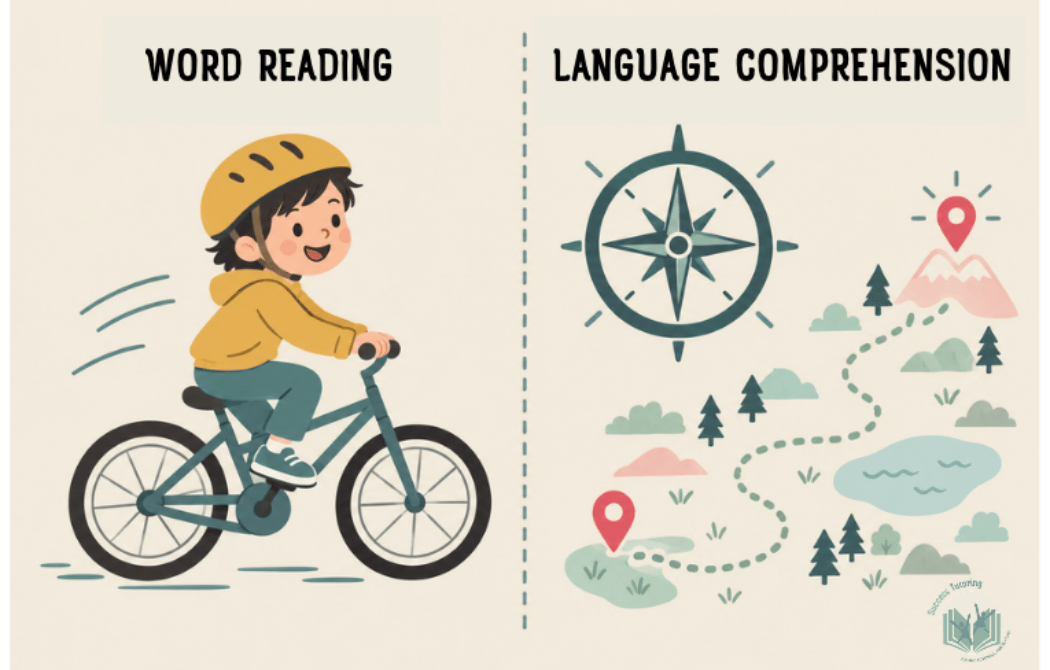
Researchers have studied this puzzle for decades, and it comes down to a handful of causes.Think of reading like riding a bike and following directions at the same time.
Pedaling is one skill. Knowing where to go and how to get there — navigation — is another. Your child can pedal fine and still end up completely lost.
In reading research, this is called the Simple View of Reading. Comprehension has two parts — word reading (pedaling) and language understanding (navigation). One without the other isn't real reading; it's just one half of it. So if your child reads beautifully but can't tell you about what they just read, they have a strong "pedaling" skill and a still-growing "navigation" skill.
Accuracy is not the same as effortless
Your child can get every word right and still be working so hard to do it that nothing is left over for meaning. Reading words needs to become automatic over time to free up mental space that can be used to make sense of the text.
Many reading programs teach words in isolation using flashcards, word lists, and "sight word" drills. While your child may learn to recognize words using these methods, numerous studies suggest that students learn best when they read words in context.
A word on a flashcard has no story, so there is nothing to attach it to in your child's memory. The same word read in a sentence within a story comes with built-in meaning and purpose. The brain has something to hold onto.
What's more, reading words in context gives your child practice with the actual job of reading, which is to attach meaning to what has been read. This is something isolated word practice cannot do.
Sentences and word parts can be confusing
Long sentences with pronouns and joining words like "although" and "unless" can make a sentence difficult for your child to follow. They might also miss the clues hidden in word parts, like un in "unhappy" or er in "walker."
We can't teach every word
In a famous analysis, vocabulary researchers William Nagy and Richard Anderson looked at the words in school books from third through ninth grade and found they contained about 88,500 distinct word families. No teacher, no tutor, no app could possibly teach 88,500 words.
Even if your child learned 10 words a day, it would take more than two decades to cover them all.
So how can your child ever learn enough words to read well? By teaching themselves — through reading.
The "built-in teacher": your child's self-teaching superpower
Reading researcher David Share proposed what is now called the self-teaching hypothesis. In plain language: once your child knows letter-sound connections well enough to decode unfamiliar words, every time they read, they are teaching themselves. Each time they successfully read a new word, their brain files awa
y details of that word — how it is spelled, how it sounds, what it means. The next time they see the word, recognition comes faster, and eventually they will read the word automatically. In this way, all words become "sight words.”
Your child's brain is also quietly soaking up patterns without anyone teaching them — a process researchers call statistical learning.
As your child reads, their brain is unconsciously keeping track of which letter patterns make words, how spelling connects to speech, which words go together, and how sentences are built. Every word, every sentence, every page adds another set of data points.
This is the same ability that lets a toddler absorb the rules of grammar long before anyone teaches them, and it is remarkably powerful: researcher Jenny Saffran and her colleagues found that even babie
s can detect patterns in speech after listening for just two minutes.
Statistical learning is one reason why the volume of reading is so important. A child who reads often and widely is giving their pattern-loving brain more and more information to file away and learn from.
When reading takes off on its own
Cognitive scientist Mark Seidenberg, author of Language at the Speed of Sight, compares learning to read to launching a rocket ship.
At first, your child needs a lot of thrust, and direct, explicit, systematic instruction provides the fuel. However, keeping the engines firing long after liftoff — by introducing every combination of letter sounds — can crowd out the mental space and time needed for comprehension.
Seidenberg says the goal is to reach "escape velocity" — the point
at which your child has cracked the code well enough that reading starts to propel itself. In other words, self-teaching. According to Seidenberg, the goal of reading instruction is to get the child to escape velocity, not to fly all the way to the moon.
So why is your child reading words without understanding what they read?First, their word reading may not be as automatic as it sounds.
Your child may sound fluent because they have memoriz
ed lots of words, but their self-teaching superpower has not yet kicked in. Reading that is automatic and effortless is necessary for comprehension. Unfamiliar words pull their attention away from understanding the text. If decoding still takes effort, there is less brain power left over to make meaning.
Second, their language understanding needs development.
Your child may be able to decode a word but not know what it means. Vocabulary, background knowledge, and inferencing grow through conversation, read-alouds, and lots of varied reading — not through word lists.
What you can do at home
You don't have to do all of this. Choose one or two suggestions at a time; otherwise, it will feel overwhelming.
Help with the words
Listen to your child read aloud and provide support and corrections as needed.
If your child makes a mistake, point to the word with your finger or a pencil and let them correct the error.
If they don't know a sound in a word, tell them the sound, have them repeat it, then go back to the beginning of the word and read it again.
Allow your child to re-read a book or story. Each reading strengthens word recognition, pattern-finding, and comprehension.
Build the meaning
Make a mistake yourself and model re-reading a sentence when it doesn't make sense.
Talk about the text. Stop to ask questions like: "Why do you think that happened?", "How do you think he felt?", and "What happened first?" These types of questions build inferencing skills naturally and work be
tter than quizzes or questions like "What was the main idea?"
Ask for a retell. After a couple of sentences, a paragraph, or a chapter, ask your child to tell you what they just read in their own words — as if they were explaining it to someone who hasn't read it.
Pick a few interesting words from the text and explain their meaning in everyday language. Ask your child for other words that mean the same thing, and have them write sentences using the new words, saying each sound as they write.
Notice word parts and how they change a word's meaning. For instance, ask how unhappy is different from happy, and how swapping the words for each other changes the meaning of the sentence.
Build the habit
Keep reading to them, even after they can read on their own. Reading aloud books above the level your child can decode on their own builds vocabulary, knowledge, and language skills.
Build background knowledge through conversation, visit museums, read non-fiction, and watch documentaries together.
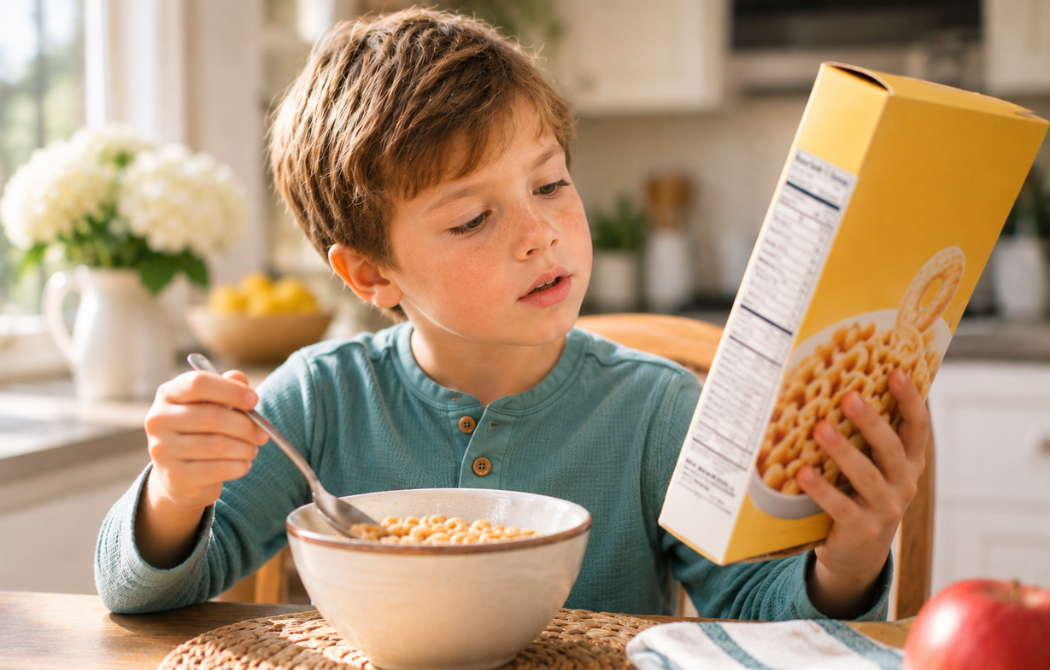
Have your child read every day, throughout the day: road signs, recipes, the back of a cereal box, non-fiction books, graphic novels, short stories, magazine articles, game directions. It all counts, and it shows your child that reading is part of everyday life.
Structured Linguistic Literacy can help
A Structured Linguistic Literacy (SLL) approach to reading instruction builds both decoding and comprehension skills.It starts with the sounds in spoken words and matches them with the different spellings that represent them.
It integrates word reading, spelling, vocabulary, and comprehension instead of teaching each skill in isolation.
It shows how the English code works by introducing different spelling patterns in words, so students can use that information to read unfamiliar words.
It emphasizes reading a wide variety of texts, repeatedly exposing students to sound-spelling connections while attaching meaning to the words in context.
It incorporates language skills by having students retell, summarize, and write about what they have read.
It teaches enough of the code so students can reach escape velocity and continue to self-teach by reading and writing extensively at home.
The bottom line
Your child is not failing at reading if they can read the words and still not understand what they read. They need to strengthen their word-reading skills, their language understanding — or both.
Success Tutoring can help your child do both, so they can read accurately and tell you all about what they just read.
Schedule a 30-minute consultation call to learn more.
Rita Santos is the founder of Success Tutoring. As a Reading Simplified Expert and an EBLI-Verified practitioner, she uses Structured Linguistic Literacy to help students, including those with dyslexia, ADHD, and processing issues, improve reading and comprehension.
Sources
Share, D. L. (1995). Phonological recoding and self-teaching: Sine qua non of reading acquisition. Cognition, 55(2), 151–218.
Castles, A., Rastle, K., & Nation, K. (2018). Ending the Reading Wars: Reading Acquisition From Novice to Expert. Psychological Science in the Public Interest, 19(1), 5–51.
Saffran, J. R., Aslin, R. N., & Newport, E. L. (1996). Statistical learning by 8-month-old infants. Science, 274, 1926–1928.
Nagy, W. E., & Anderson, R. C. (1984). How many words are there in printed school English? Reading Research Quarterly, 19(3), 304–330.
Nation, K. (2019). Children's reading difficulties, language, and reflections on the simple view of reading. Educational Psychology, 39(6), 711–717.
Seidenberg, M. (2017). Language at the Speed of Sight: How We Read, Why So Many Can't, and What Can Be Done About It. Basic Books.
Loewus, L. (2026). The Cost of Over-Teaching Phonics. Education Next, 26(2).